February 26, 2026
Navigating BS5837:2012: A Comprehensive Guide to Trees and Development
When planning a new development or property extension, trees are often viewed as eyesores and obstacles. However, the vital greens serve as assets that local planning authorities protect with rigor. In Ireland and the UK, the gold standard for managing this relationship is BS5837:2012, also called “Trees in relation to design, demolition, and construction – Recommendations.” Navigating these regulations requires professional expertise to ensure every project is a success. At GEOTREE, we provide specialised tree management consultancy needed to guide you through every stage of this process.
What is BS5837:2012?
The BS5837:2012 standard is the industry benchmark when you’re assessing how trees should be managed, especially during the development process. Most local planning authorities require compliance with this standard before they will even validate a planning application, and its goal is to identify which trees are high-quality and worthy of retention, and which may be removed to facilitate the build.
The Foundation: The Tree Survey
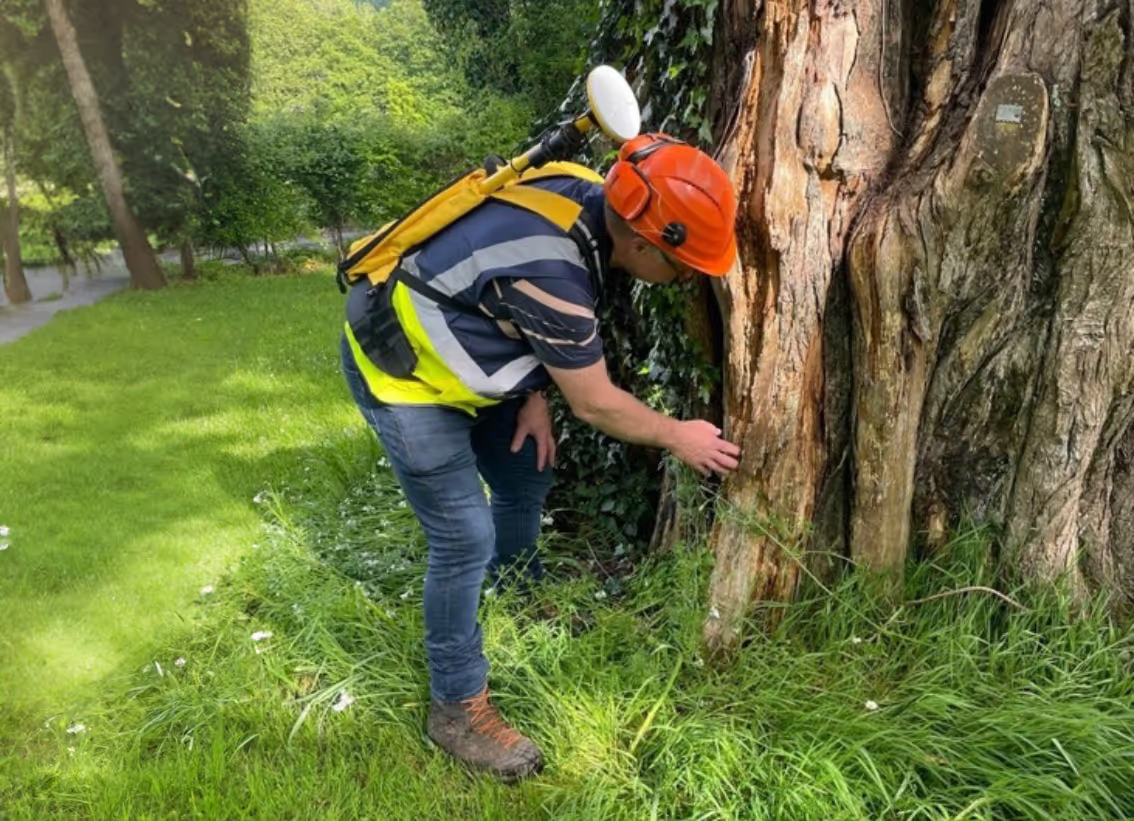
The BS5837:2012 process begins with a tree survey. During this initial stage, an arboriculturist visits the site to record data on every tree within influencing distance of the proposed works. This includes measuring stem diameters, crown spreads, and overall physiological health.
Each tree is then assigned a category
- Category A: High-quality with long life expectancy (40 years of remaining life).
- Category B: Moderate quality (20 years of remaining life).
- Category C: Low quality, which are usually small or unremarkable trees (at least 10 years of remaining life).
- Category U: Trees in such poor condition that they are unsuitable for retention.
By categorising trees early, developers can design layouts that avoid the most valuable specimens, reducing the risks of costly delays or legal disputes later.
Mapping Constraints and Protection
Once the tree survey is complete, the data is used to create a Tree Constraints Plan (TCP). This map illustrates the Root Protection Area (RPA) for each tree. You must duly note that the RPA is a “no-go zone” where construction activities could create fatal damage to the roots.
At GEOTREE, we utilise advanced GNSS and GIS technology to provide centimetre-level accuracy for these plans. Our tree management consultancy ensures that these constraints are clearly communicated to your team. This precision allows architects to overlay their site plans directly onto our tree data, ensuring that buildings, roads, and utilities do not infringe on the root systems.
Beyond the Survey: Arboricultural Impact Assessment (AIA)
A survey alone is often not enough to satisfy planning officers, and you will most likely need an Arboricultural Impact Assessment. This report evaluates the relationship between the proposed design and the existing trees. It quantifies tree loss and proposes mitigation processes, such as new planting schemes, to offset any environmental impact.
If your project is approved, the next step is the Arboricultural Method Statement (AMS). This document serves as an instruction manual for the construction team. This file also details exactly how retained trees will be protected on-site. It covers everything from the installation of protective fencing to “no-dig” construction techniques for driveways located near root zones.
Why Professional Tree Management Consultancy Matters
Navigating BS5837:2012 without professional help can make you gain massive setbacks. Inaccurate tree surveys can result in rejected planning applications, or worse, irreversible damage to the trees. This can lead to heavy fines and a complete halt to construction.
By partnering with us, you gain access to 20 years of arboricultural experience. At GEOTREE, we pride ourselves on delivering precise, science-based data that simplifies the planning process. Our team of experts works closely with stakeholders to find practical solutions that meet both ecological standards and development objectives.
Final Word
Compliance with BS5837:2012 is a fundamental part of development. A professional tree survey and a well-executed protection plan are the best ways to ensure your project respects the local landscape while meeting regulatory requirements.
If you are beginning a new project and you need expert guidance, you may contact us at GEOTREE to learn how our tree management consultancy can support your vision. Together, let us help you turn environmental constraints into sustainable design opportunities.
More Blog Posts from GEOTREE...